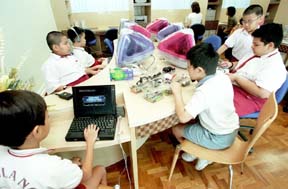
Year 2002 is the target year for all
schools in Singapore to have students using computers for 30 per cent
of curriculum time.
By next year, schools should also be so well-equipped
that there will be one computer for every two students.
This was outlined in the Masterplan for IT in Education,
launched by the Ministry of Education (MOE) in 1997 and designed to
align students with Singapore’s globalisation, in which IT will feature
prominently.
The aim is to prepare students for the challenges of
the future by providing them with an IT-enriched school environment.
Now that the masterplan has been in force for almost
four years, how has it fared and what progress has been made?
"The core training for teachers has been completed,"
said Miss Tham Yoke Chun, assistant director of IT training at the educational
technology division of MOE, "The basic IT provisions are also in
place."
Teachers have been equip-ped with the basic skills and
expertise to select and evaluate appropriate IT resources to use in
their lessons. Some have even gone on to innovate and experiment with
different types of technology in their classrooms, she added.
"The IT culture in schools is stronger than before,
and schools are generally more fluent in their use of technology for
teaching, learning and administration."
Some teachers are still grappling with the emphasis
on IT, and find infusing IT into the classroom an uphill task. On the
other hand, some IT-savvy teachers are even writing their own software.
All in all, a critical mass of IT-savvy teachers has
been created, said Miss Tham.
Since the launch of the masterplan, the key challenge has been in changing
teaching practices.
Said Miss Tham: "Students are more IT-savvy and
media-literate. The Internet has opened up new channels of communication
and a wealth of resources, and information became more readily accessible
than before."
Teachers, therefore, had to rethink some of the fundamentals.
For example, their role as givers of information changing to that of
a facilitator of learning, and the role of the textbooks in relation
to the wealth of Internet resources to be tapped.
"Now, teachers are challenged to exploit the potential of this
new educational tool effectively," Miss Tham added.
"It was like the time teachers migrated from blackboards
to OHPs (overhead projectors). A new tool can help them only if they
capitalise on it appropriately.
"To do that, teachers have to understand the tool, explore, devise
and innovate different ways of harnessing IT.
"IT is available, but it’s a means to an end,
not an end in itself. There’s no point for teachers to use IT just
for the sake of using it. They must know how it adds value as an educational
tool," said Miss Tham.
Just as there have been challenges along the way, there
have also been breakthroughs.
For instance, as IT becomes a more integral part of
teaching, learning and administration, the IT culture is fast gaining
ground in schools.
Noted Miss Tham: "The learning environment now
is richly IT-enabled. Both students and teachers have become more IT-literate,
not just in terms of IT skills but also in terms of selecting and applying
appropriate IT tools to support their work.
"Many students are gaining greater confidence and
are more communicative. There is also a growing culture of sharing among
teachers, as evident from the active sharing of lesson ideas and resources
during IT in education seminars and at sharing sessions at the Teachers’
Network."
Awards
Proof of the masterplan’s success is also evident in Singapore students
winning top awards in international website design competitions like
Thinkquest Internet Challenge.
In Thinkquest, local students team up with other students
from overseas to design a website. Because of their different geographical
locations, they have to utilise IT to be successful in communicating
and collaborating.
"Outside of the US, Singapore has the largest number of participants
and finalists in this competition," said Miss Tham.
"It sounds like a cliché, but we are really looking at creating
borderless classrooms. In fact, enhancing links between schools and
the rest of the world is one of the main goals of the masterplan.
So, the masterplan appears to be right on schedule. But what happens
after 2002?
Miss Tham revealed that MOE has a project team working on mapping the
next phase of IT in education. It is still discussing "how we should
move" after this masterplan is completed.
Main ITmasterplan goals
- Enhance links between the school and the world around it.
Teachers and students are encouraged to communicate and collaborate
with other institutions and tap the wealth of educational resources.
- Generate innovative processes in education.
Schools are encouraged to develop new teaching and learning strategies
and open up new possibilities for curricula and assessment. They are
also given the autonomy to deploy IT resources flexibly.
New school designs also seek to maximise the potential for the use of
IT to enhance teaching and learning.
- Enhance creative thinking, lifelong learning and social
responsibility.
Teachers use IT-based learning strategies to develop abilities in students
to think flexibly and creatively, cooperate with one another and make
sound value judgements.
- Promote administrative and management excellence in
the education system.
IT is used to promote greater efficiency in administration and communication,
and effective educational management.
IT usage in schools
- As a resource. Teachers and students tap into the Internet and other
rich digital media for information.
Teachers create online learning resources to complement face-to-face
learning environments or to provide an additional resources for self-paced
and independent learning.
- As a collaborative and communication tool. Some teachers
use communicative modes such as e-mail and threaded discussions to encourage
students to express their views and learn to see things from multiple
perspectives, and to use the Internet in project work.
Others use the collaborative and communication capabilities
to expand the classroom boundaries by bringing in
e-mentors from the community or by engaging their students in collaborative
projects with overseas schools.